Expanding Early Childhood Degree Access
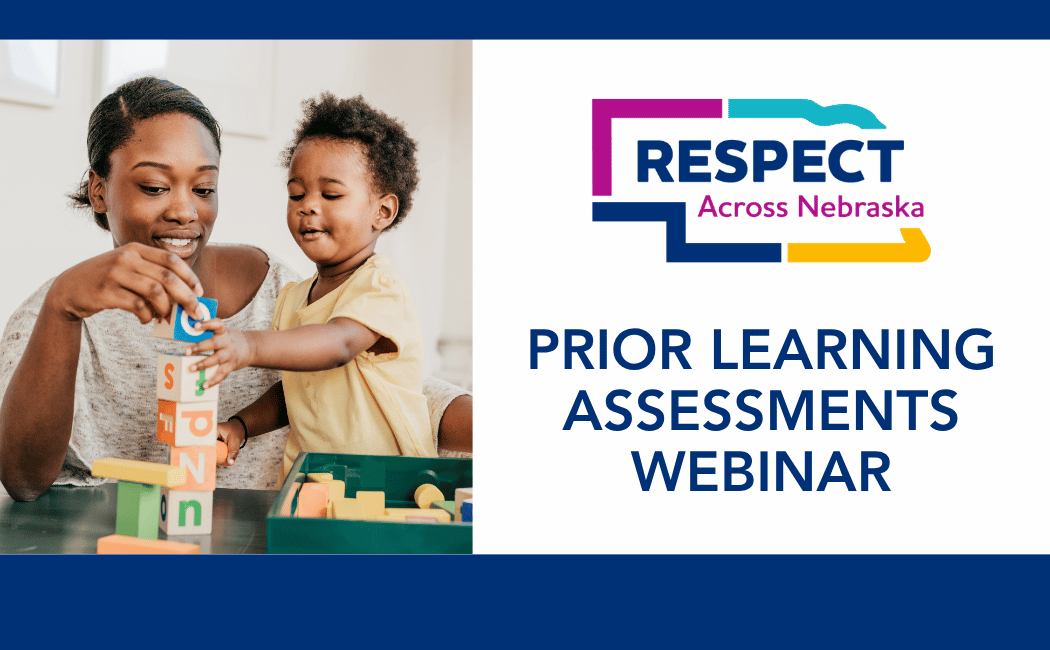
On March 30, RESPECT Across Nebraska brought together a diverse group of participants from Nebraska and across the country for a webinar on “Prior Learning Assessments: Expanding Access in Early Childhood Education.”
The session created space for early childhood educators, higher education faculty and staff, ESU leaders, and representatives from nonprofits, foundations and government agencies to explore how Prior Learning Assessments (PLA) can strengthen and expand pathways into early childhood degree programs.
Participants represented a wide range of institutions, including public and private colleges and universities, Tribal colleges, community colleges, state agencies and early childhood organizations. Nebraska-based institutions were well represented alongside national partners, reflecting both the local and broader reach of this work.
As shared during the webinar, “Prior learning assessments are a mechanism through which [adult learners’ knowledge and skills] can be recognized and validated.”
This purpose grounded the webinar, emphasizing why PLA is so critical in early childhood education: recognizing the experience and expertise educators already bring to the field, reducing barriers to degree completion and expanding access to higher education pathways.
A recording of the webinar is now available.
PANEL INSIGHTS
The webinar featured a panel of four speakers from higher education institutions across the country, each sharing how PLA is being implemented within their systems:
- Lisa Downey (National Louis University) highlighted a competency-driven degree program that allows students to demonstrate existing knowledge through assessments, portfolios and credentials, while reducing learning duplication and accelerating degree completion.
- Diana Schaack (University of Colorado Denver) shared a statewide, policy-driven approach in Colorado, where institutions collaborate to create durable, transferable PLA and credit-for-learning systems that recognize professional training and credentials across institutions.
- Caroline Soga (Honolulu Community College) discussed multiple PLA models, including credit-by-exam, portfolio-based assessments and non-credit-to-credit pathways, all designed to create accessible “on-ramps” for working professionals.
- Lisa Guenther (Northeast Community College) focused on simplifying the PLA process at the institutional level, emphasizing clear pathways, faculty-supported portfolio reviews and efforts to remove financial barriers for students.
Together, these presentations highlighted a range of approaches, from institutional practices to statewide systems all aimed at recognizing prior learning and supporting adult learners in early childhood education.
KEY tAKEAWAYS
- PLA can increase access to higher education by valuing prior experience and knowledge.
- Clear and consistent processes are essential for effective implementation across institutions.
- Collaboration across colleges, universities, and community partners strengthens student pathways.
- Ongoing support, such as advising, mentorship, and navigation, is critical to student success.
The webinar also reinforced the importance of continued collaboration and system-building. Across the presentations, speakers emphasized the need for alignment across institutions, sustainable policies, and shared understanding to ensure PLA efforts are scalable and durable over time.
NEXT STEPS
As a next step, RESPECT will continue to convene partners, share resources and support institutions in advancing PLA efforts. The webinar also sparked interest among participants in ongoing collaboration and knowledge-sharing across institutions and states.